Feel free to leave some comments to fuel a discussion!
Showing posts with label critical response. Show all posts
Showing posts with label critical response. Show all posts
Wednesday, May 29, 2013
Arrested Development Season 4 and the Future of TV Thoughts
I've spent the past few weeks watching all three seasons of Arrested Development on Netflix in anticipation of the release of season four. Now it's out, and Kyle and I thought we'd do a vlog where we discuss our initial reactions to the season (we're still in the process of watching it all) and also commenting on where we think TV watching in general is heading.
Feel free to leave some comments to fuel a discussion!
Feel free to leave some comments to fuel a discussion!

Wednesday, May 15, 2013
We Review "The Great Gatsby" Movie
In this vlog, Kyle and I give our thoughts on "The Great Gatsby," out in theaters now. We had to film this vlog three times because for some reason, our camera (we were using a Canon 7D) would stop recording every now and then. So that was a pain.
It's a little longer than some of the previous videos, but we had a lot to say about this movie. Please, if you haven't done so already go and subscribe to us on YouTube!
PS - We are filming today for this week's Sunday skit!
It's a little longer than some of the previous videos, but we had a lot to say about this movie. Please, if you haven't done so already go and subscribe to us on YouTube!
PS - We are filming today for this week's Sunday skit!
Sunday, April 14, 2013
Response to "Masters of Photography" documentary
Holy crazy hair Batman.

I really enjoyed looking at all the photographs in this documentary, most of them pictures of people, while hearing quotes from Diane Arbus, as well as hearing other people talk about her who knew her.
One thing in particular that stood out was Marvin Israel talking about how for Diane, it was always about the experience of the photograph was important rather than about the photograph itself. That really stood out for me, because I feel like a lot of people are really obsessed with taking really great technical pictures, of taking really beautiful pictures, but for me that's not what it's about at all. It's not about taking a photograph and making it as beautiful as possible, it's about capturing the beauty of the moment itself as it occurs. The spontaneity and the experience itself makes the photograph beautiful.
Another thing I found interesting that was mentioned was that Diane liked "photographing freaks." It's interesting, again, because so often people are caught up in photographing a beautiful subject, but Diane found something beautiful or interesting in people who were maybe not objectively attractive, or were somehow different from the norm. It's a different kind of beauty, but I still find it very interesting that she chose to photograph those kinds of people.
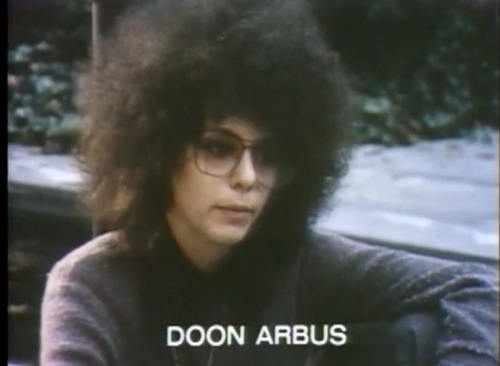
I really enjoyed looking at all the photographs in this documentary, most of them pictures of people, while hearing quotes from Diane Arbus, as well as hearing other people talk about her who knew her.
One thing in particular that stood out was Marvin Israel talking about how for Diane, it was always about the experience of the photograph was important rather than about the photograph itself. That really stood out for me, because I feel like a lot of people are really obsessed with taking really great technical pictures, of taking really beautiful pictures, but for me that's not what it's about at all. It's not about taking a photograph and making it as beautiful as possible, it's about capturing the beauty of the moment itself as it occurs. The spontaneity and the experience itself makes the photograph beautiful.
Another thing I found interesting that was mentioned was that Diane liked "photographing freaks." It's interesting, again, because so often people are caught up in photographing a beautiful subject, but Diane found something beautiful or interesting in people who were maybe not objectively attractive, or were somehow different from the norm. It's a different kind of beauty, but I still find it very interesting that she chose to photograph those kinds of people.
Wednesday, April 3, 2013
Response to "Jon"
What a crazy story.
The most compelling and memorable thing about "Jon" is the way it is written. It sounds like it's written by a child, or someone who is uneducated, because there is a certain disregard for conventional sentence structure, the word "like" is used a lot, there aren't quotation marks... there are just a lot of errors that you might see a child just learning to write make. This makes it hard to understand the story sometimes, but it also provides a unique, interesting voice.
The story itself was compelling, though very strange. I found myself drawn in by the protagonist's voice, empathizing with his desire for real connection with a person rather than with, well, his hand. I can also understand the desire to exit his situation as a product tester (?). In today's consumer society, sometimes it feels like that's what the consumer is.
I enjoyed reading the story, though.
The most compelling and memorable thing about "Jon" is the way it is written. It sounds like it's written by a child, or someone who is uneducated, because there is a certain disregard for conventional sentence structure, the word "like" is used a lot, there aren't quotation marks... there are just a lot of errors that you might see a child just learning to write make. This makes it hard to understand the story sometimes, but it also provides a unique, interesting voice.
The story itself was compelling, though very strange. I found myself drawn in by the protagonist's voice, empathizing with his desire for real connection with a person rather than with, well, his hand. I can also understand the desire to exit his situation as a product tester (?). In today's consumer society, sometimes it feels like that's what the consumer is.
I enjoyed reading the story, though.
Monday, March 25, 2013
Response to "Images" by Robert Hass
"Images" by Robert Hass is, predictably, full of images. He begins by describing his house late at night when everyone is asleep. And immediately, the reader visualizes the scene in his mind.
Hass then goes on to discuss several poems, namely haikus. He discusses the the images contained in such few words and tries to articulate what makes them so compelling. As I read through the various images Hass describes in the article, I kept thinking about something I had been told about writing descriptively: write using all the senses. Describe what can be seen, heard, felt, smelled (smelt?), and tasted in a scene. I think that, used correctly, this evokes an emotional reaction, a feeling.
At one point Hass says:
Hass then goes on to discuss several poems, namely haikus. He discusses the the images contained in such few words and tries to articulate what makes them so compelling. As I read through the various images Hass describes in the article, I kept thinking about something I had been told about writing descriptively: write using all the senses. Describe what can be seen, heard, felt, smelled (smelt?), and tasted in a scene. I think that, used correctly, this evokes an emotional reaction, a feeling.
 |
| For us Midwesterners, I'm sure this image evokes a very strong emotional reaction. |
At one point Hass says:
"Images are not quite ideas, they are smaller than that, with less implication outside themselves. And they are not myth, they do not have that explanatory power; they are nearer to pure story. Nor are they always metaphors; they do not say this is that, they say this is" (275).When I read this, I thought about my own process as a filmmaker. It's not uncommon for me to first come up with an image: an old man in a long coat and top hat, holds and umbrella waits outside at the shoreline in pouring rain as an old ship emerges from thick fog and begins to dock. The image comes first, and along with it a feeling, and then I develop a story based on that. Good imagery conjures up these feelings.
Monday, March 18, 2013
Response to "Living With Cancer"
 |
| Credit John Klein Wilson / Michigan Radio |
I'm also inspired by the stories of support people receive during their treatment. A number of people in the broadcast mention that support from family and friends is so important to the healing process, almost in a spiritual sense. Knowing that you have someone who is there for you, who wants you to get better, must be a great feeling, and I'm sure it helps.
As inspiring as these stories are, not everyone who is diagnosed with cancer survives. There are many different kinds of cancer and some are much more difficult to treat than others. Hearing about kids getting cancer, even newborn babies, is horrible and is something that shouldn't happen. Parents should not be losing kids to disease like this, and the good news is that doctors are continuing to try their hardest to find better treatment options and a cure. It may still be a ways off, but we get closer to finding the answer every day.
Sunday, March 10, 2013
Response to "Sound Reporting"
 |
dsearls under CC-BY-SA licence under CC-BY-SA licence |
The first part of the reading was really selling radio, and it was doing a decent job until it started listing things to keep in mind. These were things like "A radio news magazine may not have readily identifiable 'sections'," "Radio listeners, unlike readers, can't skip a story or segment of a program,"and "People can't relisten to a story, the way they can reread a newspaper article." I understand that the section was trying to show creators why making great content is a must, but as a consumer it seemed as though I was just reading a list of why TV or Internet news was better than radio.
But "Sound Reporting" is right about radio persisting even in the face of new media journalism and programming. It may have diminished in importance, but it's definitely still around and it appears as though it will stay that way. So the next part of the reading I found very compelling. The writer discussed how to create great content for the radio, which will be very helpful when I make my own radio content here in the next couple of weeks.
The overall theme here is simplification. Whatever you do, make it easy for the average listener to understand, and make it entertaining so that you hold their attention. Speak as though you're talking to one person as opposed to many, and speak like you would in real life, minus all the "uh"s and "um"s.
I found the reading to be very informative, and I plan on using what I've learned for my upcoming projects.
Monday, February 25, 2013
Listening In - Response
 |
| Image taken from the Flickr photostream of Sveeta Bogomolova and used under a Creative Commons Licence. |
Reading this article, I was struck by how nostalgic I felt thinking about sitting around the radio at night with my family, listening in, or laying in bed late at night listening. But those things never happened; I was feeling nostalgic about something I never actually experienced.
That's not to say radio didn't have some effect on my life. As I've said in a previous post, when I was younger every morning in the car on the way to school my mom would have Mojo in the Morning on, and we would listen to things like the war of the roses segment or the prank calls. I remember always being sad that I couldn't finish the segments; it was a short drive to school.
As a kid, I also would make fake radio stations with my friend David. He had a karaoke machine, and we would talk like hosts into the microphone and play our CDs, while recording the whole thing onto casette tapes.
But I never went out for a drive late at night and listened to the radio, alone or with friends. Nowadays I always have my iPod with me, so I just listen to that if I'm out driving. Yet reading this article, I long to experience this type of listening. I think that's what the article has going for it, but I know that I only like the idea of radio; if I were to actually go back in time I'm fairly certain I would get bored.
There are commercials in radio! And people remember all of the great hosts and segments and music, but radio was on 24/7; it couldn't possibly be good all the time. I believe it's a romanticized memory. This isn't to say that there couldn't have been great content on the air, I'm sure there was, but there was also mediocre content, as with any medium, and I feel like I would get bored with radio.
Plus I have grown up in a fast paced world where people want what they want and they want it now. Today there's no time for bad content; if you're not creating something good and interesting I'm gonna tune it out. I have a short attention span and something needs to capture my attention in seconds or else I'll move on. This may not be true for everyone, and this isn't to say that I don't give things a chance, but I need to be hooked.
I'm not trying to say that radio today is bad or that watching TV or watching a movie is a better experience; in class I really liked the audio segments we listened to. Also, I didn't grow up in the era of radio so of course I'm going to have a different opinion of it. I'm sure older generations feel nostalgia for having actually experienced the things the article talks about. I know it was a very important cultural phenomenon.
One last thought. The radio talks about how people enjoyed radio so much because they were an active participant, because it stimulated their imagination. They could hear what was happening but needed to fill in the blanks. I think this idea of the "active participant"is really important in all mediums, but most important perhaps in radio. So in creating my own content, I need to keep this idea in mind.
Sunday, February 10, 2013
Response to "Writing Movies for fun and Profit"
The reading from "Writing Movies for fun and Profit" reminded me a lot of SAC 310, the screenwriting class here at UM. Except it was even less sugar-coated, if that were possible. People hate to think about movies as having such a clear-cut structure that is the same in almost every movie, but it's true.
In the article, though, they said the inciting incident appears exactly on page 10, and I had a problem with that. It's true that there is a structure that is followed, and it doesn't vary that much from script to script, but it DOES change a little. Things don't occur exactly on certain pages in every script, but they do appear around those pages.
Of course, this is kind of the point; they are embellishing just a bit for the sake of demystifying the process of screenwriting.
This article was a summary of a number of other screenwriting books I had to read for class (and some for fun) and it's always weird to hear everything laid out so plainly. Because the fact is, movie-making is not a mystical process, it is an industry, a well-oiled machine. You could argue that independent feature films are made a little differently, but when it comes to Hollywood, it is a business that has been around for a long time. That's why we keep getting movies split into two (I HATE THAT); as long as the movies keep making money, this trend is going to continue.
This reading felt like one prolonged slap in the face. For instance:
These elements, the article argues, NEED to be there in the script. It's a strange dichotomy between "real life" and "fantasy," but you can't lean too far to one direction or the other or you'll lose your audience.
I think they're right, but the way they deliver their message, as I said, is like them saying "Dummy, look at how things are!" I haven't decided yet if I think this is effective or not, because reading this made the rebel in me want to argue with them, even though I think they make some good points.
Regardless, "Writing Movies forfun and Profit" is the definition of no-nonsense writing, and it made for an interesting read.
In the article, though, they said the inciting incident appears exactly on page 10, and I had a problem with that. It's true that there is a structure that is followed, and it doesn't vary that much from script to script, but it DOES change a little. Things don't occur exactly on certain pages in every script, but they do appear around those pages.
Of course, this is kind of the point; they are embellishing just a bit for the sake of demystifying the process of screenwriting.
This article was a summary of a number of other screenwriting books I had to read for class (and some for fun) and it's always weird to hear everything laid out so plainly. Because the fact is, movie-making is not a mystical process, it is an industry, a well-oiled machine. You could argue that independent feature films are made a little differently, but when it comes to Hollywood, it is a business that has been around for a long time. That's why we keep getting movies split into two (I HATE THAT); as long as the movies keep making money, this trend is going to continue.
This reading felt like one prolonged slap in the face. For instance:
"Your heroine should be as real as your first crush--only she's carrying the plans to destroy the Death Star and she looks great in a bikini."
 |
| As far as I know, no one objected to this rule. |
I think they're right, but the way they deliver their message, as I said, is like them saying "Dummy, look at how things are!" I haven't decided yet if I think this is effective or not, because reading this made the rebel in me want to argue with them, even though I think they make some good points.
Regardless, "Writing Movies for
Wednesday, February 6, 2013
Reality TV: Why Do So Many People Watch It?
In "Reality Hunger: A Manifesto: Why the Lyric Essay is Better Than Fiction", David Shields points out that most "art" tries to get as close to reality as possible. This may not be true in every single case, but he makes a good point.
My first instinct after reading Shields as well as this article was to write about whether reality TV is art or not. However, I think this question is fundamentally unanswerable; art is a broad term that is difficult to define (although Wikipedia tries really hard). And in many ways, whether or not reality TV has artistic value or not is irrelevant because people watch it anyway. So I decided that I would talk about why I think this is.
I don't watch a lot of reality TV; it's just not something I've ever had much interest in watching. I hope that doesn't come across as me sounding pretentious, because that's not how I mean it. I've just never gotten into reality TV.
Last fall, my roommates got caught up in a TLC show called "Breaking Amish." They started watching it as a joke: someone saw a commercial for it and thought it looked funny, they were bored one Sunday night and started watching it "as a joke." But at some point between the first and last episode of the season, it stopped being a joke and just became a show they watched.
My sister is really into reality shows. I've seen her annihilate seasons of Dance Moms (fun fact, a friend of ours was actually on the show) and if it has to do with cake or dresses, chances are she's seen it. I would say she watches reality TV about as much as she watches Dawson's Creek or One Tree Hill or Gilmore Girls.
My point with these examples is that although I don't personally watch reality TV, I understand their appeal to viewers completely. It gives people a chance to watch how "real people" react in "real situations." They can follow the lives of complete strangers, which is strangely compelling. Especially since reality programs are usually not actually 100% real. Some shows slightly over-dramatize situations, while others are largely fictional.
But that's okay. They don't have to be real; they just have to be real enough.
I've definitely fallen victim to this. For class this week we were supposed to familiarize ourselves with lonelygirl15 and her universe. So I watched the first vlog she made. Then I watched the next one. And the next one. And so on and so forth, until I was about 40 videos in. They were simple videos in typical vlog format. Nothing much happened in them (at least in the beginning). I knew they weren't real. And yet I kept watching.
Maybe "reality" programming appeals to the voyeur in all of us. Maybe it's our ability to empathize with people. But we get sucked into the lives of these people, and I think part of it has to do with the illusion of reality involved. We can get into serial television shows (for me, it was Lost; try and tell me the pilot episode isn't compelling), but I think it's much easier for people to get hooked on reality TV because the people we're watching ARE, in fact, people, not characters. Most people can look past the fact that what they are watching isn't completely real because most stories require a suspension of disbelief.
There's been a lot of talk about how reality shows are horrible programs and how they are destroying our brain cells (which I think is over-generalizing), but I do believe that reality programming can be a legitimate storytelling platform. Tons of people watch reality shows and are likely to continue doing so.
(NOTE: I wanted to clarify; the lonelygirl15 videos were scripted and fictionalized, they weren't really reality programming. But the videos presented themselves as real life so the illusion of reality as a way of drawing in viewers applies).
My first instinct after reading Shields as well as this article was to write about whether reality TV is art or not. However, I think this question is fundamentally unanswerable; art is a broad term that is difficult to define (although Wikipedia tries really hard). And in many ways, whether or not reality TV has artistic value or not is irrelevant because people watch it anyway. So I decided that I would talk about why I think this is.
I don't watch a lot of reality TV; it's just not something I've ever had much interest in watching. I hope that doesn't come across as me sounding pretentious, because that's not how I mean it. I've just never gotten into reality TV.
Last fall, my roommates got caught up in a TLC show called "Breaking Amish." They started watching it as a joke: someone saw a commercial for it and thought it looked funny, they were bored one Sunday night and started watching it "as a joke." But at some point between the first and last episode of the season, it stopped being a joke and just became a show they watched.
My sister is really into reality shows. I've seen her annihilate seasons of Dance Moms (fun fact, a friend of ours was actually on the show) and if it has to do with cake or dresses, chances are she's seen it. I would say she watches reality TV about as much as she watches Dawson's Creek or One Tree Hill or Gilmore Girls.
My point with these examples is that although I don't personally watch reality TV, I understand their appeal to viewers completely. It gives people a chance to watch how "real people" react in "real situations." They can follow the lives of complete strangers, which is strangely compelling. Especially since reality programs are usually not actually 100% real. Some shows slightly over-dramatize situations, while others are largely fictional.
But that's okay. They don't have to be real; they just have to be real enough.
I've definitely fallen victim to this. For class this week we were supposed to familiarize ourselves with lonelygirl15 and her universe. So I watched the first vlog she made. Then I watched the next one. And the next one. And so on and so forth, until I was about 40 videos in. They were simple videos in typical vlog format. Nothing much happened in them (at least in the beginning). I knew they weren't real. And yet I kept watching.
Maybe "reality" programming appeals to the voyeur in all of us. Maybe it's our ability to empathize with people. But we get sucked into the lives of these people, and I think part of it has to do with the illusion of reality involved. We can get into serial television shows (for me, it was Lost; try and tell me the pilot episode isn't compelling), but I think it's much easier for people to get hooked on reality TV because the people we're watching ARE, in fact, people, not characters. Most people can look past the fact that what they are watching isn't completely real because most stories require a suspension of disbelief.
 |
| Some shows require a lot of suspension of disbelief... Man, I miss it. |
There's been a lot of talk about how reality shows are horrible programs and how they are destroying our brain cells (which I think is over-generalizing), but I do believe that reality programming can be a legitimate storytelling platform. Tons of people watch reality shows and are likely to continue doing so.
(NOTE: I wanted to clarify; the lonelygirl15 videos were scripted and fictionalized, they weren't really reality programming. But the videos presented themselves as real life so the illusion of reality as a way of drawing in viewers applies).
Monday, February 4, 2013
Some Thoughts on Camp, "Hansel and Gretel," and "The Room"
"Camp is a vision of the world in terms of style -- but a particular kind of style. It is the love of the exaggerated, the "off," of things-being-what-they-are-not." "Notes on 'Camp'", Susan SontagA couple weeks ago, a group that I'm a part of on campus called MFlicks hosted an early screening of "Hansel and Gretel: Witch Hunters" which, first of all, I really enjoyed. To me, this is a camp film.
It didn't get very good reviews, and I wouldn't expect it to. I went into the screening knowing it was going to be ridiculous (re: the title) so I went in with those expectations and I wasn't disappointed. There were cheesy one-liners, stylized violence, anachronistic weapons, and on and on. It was not an accurate depiction of the time period, people didn't all speak with Olde English accents, and that was okay. "Hansel and Gretel" as Sontag says, is exaggerated. It's an intentional stylistic choice, and in my opinion, that's what made the film work.
In Douglas Wolks "Notes on Art so Bad It's Good," a reaction to Sontag's original article, he describes the term SOBIG (so bad it's good). This immediately made me think of a little film called "The Room." If you haven't heard of it, watch the trailer in its entirety right this second.
I saw "The Room" last spring at the State Theater, and it was an awesome experience. I hope you watched the trailer, because it's hard for me to even describe what happens in the movie. But when the film is shown, it is always an event. Similarly to "Rocky Horror Picture Show" screenings, people are encouraged to interact with the film as it is being shown. People in the theater shout at the screen and throw spoons.
Of course, "The Room" is awful as a serious movie. The acting is extremely overdone and there are plot holes left and right. But it's so bad it's good.
"The Room" is playing at the State on March 16, and I highly recommend going. Make sure you get there early, since there will be a long line and people at the back will not get in. And bring some spoons.
Sunday, January 27, 2013
Branding in the Digital Age/Personal Media Strategy response
The thing that I found most interesting about the article "Branding in the Digital Age: You're Spending Your Money in All the Wrong Places"is the statistic that stated that fewer than 1 in 10 shoppers visited the manufacturer's websites of the product they were interested in buying. Here are companies that are spending tons of money making sure these websites are up and running, and filled with information, and the research shows that most people don't ever visit these sights.
The article goes on to explain that people use websites such as Amazon to find products and to do their research, and that as a result companies started providing links back to their site. I know that for me, when I am interested in buying something, I usually will go on Amazon in order to compare prices and see reviews. It's an easy way to help narrow down your options, especially since today it seems like there are so many options.
For example, I went on Amazon just before Christmas to look for a record player. The search results gave me some of the top picks, which I could sort by rating or price, both of which are important to me. And from this, I was able to narrow it down to a record player that I wanted to buy. It seems to me, then, that the strategy for companies here should be to make sure that their products receive top results on sites such as Amazon, and that comes down to having a product that warrants good reviews, and having a customer base that cares enough about the product to take time out of their day to write about it.
This idea of building a customer base that cares ties into the other article, "What's Your Personal Social Media Strategy?" For businesses, social media's role should be not just about giving people exposure to products, but it should be about generating a dialogue with consumers and building a relationship with buyers, both potential and existing. I think Taco Bell (@TacoBell) does a really good job of this on Twitter, as evidenced by these responses that Buzzfeed collected.
They reached out to their audience in a funny way; I think it's really important to show that they have a sense of humor, because it makes them seem like more than just a huge chain. They're raising awareness about their fast food restaurants, but they're also reaching out to people on a more personal level, and this could only help sales.
The article goes on to explain that people use websites such as Amazon to find products and to do their research, and that as a result companies started providing links back to their site. I know that for me, when I am interested in buying something, I usually will go on Amazon in order to compare prices and see reviews. It's an easy way to help narrow down your options, especially since today it seems like there are so many options.
For example, I went on Amazon just before Christmas to look for a record player. The search results gave me some of the top picks, which I could sort by rating or price, both of which are important to me. And from this, I was able to narrow it down to a record player that I wanted to buy. It seems to me, then, that the strategy for companies here should be to make sure that their products receive top results on sites such as Amazon, and that comes down to having a product that warrants good reviews, and having a customer base that cares enough about the product to take time out of their day to write about it.
This idea of building a customer base that cares ties into the other article, "What's Your Personal Social Media Strategy?" For businesses, social media's role should be not just about giving people exposure to products, but it should be about generating a dialogue with consumers and building a relationship with buyers, both potential and existing. I think Taco Bell (@TacoBell) does a really good job of this on Twitter, as evidenced by these responses that Buzzfeed collected.
 |
| Dang, now I really want Taco Bell. |
They reached out to their audience in a funny way; I think it's really important to show that they have a sense of humor, because it makes them seem like more than just a huge chain. They're raising awareness about their fast food restaurants, but they're also reaching out to people on a more personal level, and this could only help sales.
Sunday, January 20, 2013
M. Wesch and the Future of Education
I found Michael Wesch's video on the state of education to be very interesting. I am attending one of the top public universities in the country, and despite that I think the current educational system is flawed, for many reasons similar to Wesch's. It's not that U of M doesn't do a good job of teaching me things, because it does. But I feel like there is a more effective way that hasn't been widely implemented yet.
I recognize that things are slow to change (this video was made like five years ago!) but I do feel that change is taking place. Every semester, professors seem more willing to incorporate images and videos and audio clips pulled from the Internet in their lectures. Students are being encouraged more and more to bring a laptop or tablet to class. Some classes even rely on the Internet as part of the lecture: one of my Sociology classes incorporated Lecture Tools, where students take notes online and can interact with the presentation material given by the professor.
There are still some holdouts; yes, some professors do not allow any technology in their classrooms, usually out of concern that students will lose focus and be multi-tasking during lecture, which is a legitimate concern. I'm curious to know just how much focus is lost, though. As a generation, and as is mentioned in the video, we are rapidly getting better and multi-tasking. Is it possible that a student could be absorbing the material while also being on Facebook? Maybe not, but it's an interesting question.
Either way, it cannot be denied that technology and the Internet have provided new interesting ways of learning and it's a type of learning that my generation is familiar with. When there is something that we don't know or something we'd like to learn more about, gaining access to that knowledge is as simple as going to Google or Wikipedia. We are online all the time, and we are constantly absorbing, and yes a lot of times it may be trivial things like pictures of cats with a Hitler moustache, but the potential is there to be taken advantage of. It's just a question of how to implement it effectively.
I like the idea of this Digital Storytelling class, and I think it could be applied to other classes as well. Couldn't an English class follow each other on Twitter for up-to-the-moment thoughts and analysis about readings or suggestions about what to read? Anthropology students could share ethnographic studies on YouTube for other students to view. I believe that learning is best accomplished when collaboration is encouraged, and one student's ideas inspire another student, who then might share his thoughts on his blog that inspires countless others.
The old way of learning may be just fine, but there is so much untapped potential that isn't being explored.
I recognize that things are slow to change (this video was made like five years ago!) but I do feel that change is taking place. Every semester, professors seem more willing to incorporate images and videos and audio clips pulled from the Internet in their lectures. Students are being encouraged more and more to bring a laptop or tablet to class. Some classes even rely on the Internet as part of the lecture: one of my Sociology classes incorporated Lecture Tools, where students take notes online and can interact with the presentation material given by the professor.
There are still some holdouts; yes, some professors do not allow any technology in their classrooms, usually out of concern that students will lose focus and be multi-tasking during lecture, which is a legitimate concern. I'm curious to know just how much focus is lost, though. As a generation, and as is mentioned in the video, we are rapidly getting better and multi-tasking. Is it possible that a student could be absorbing the material while also being on Facebook? Maybe not, but it's an interesting question.
 |
| "What? I'm live-tweeting the lecture to my friend 'cause she's sick!" Photo by Raffi Asdourian. |
Either way, it cannot be denied that technology and the Internet have provided new interesting ways of learning and it's a type of learning that my generation is familiar with. When there is something that we don't know or something we'd like to learn more about, gaining access to that knowledge is as simple as going to Google or Wikipedia. We are online all the time, and we are constantly absorbing, and yes a lot of times it may be trivial things like pictures of cats with a Hitler moustache, but the potential is there to be taken advantage of. It's just a question of how to implement it effectively.
I like the idea of this Digital Storytelling class, and I think it could be applied to other classes as well. Couldn't an English class follow each other on Twitter for up-to-the-moment thoughts and analysis about readings or suggestions about what to read? Anthropology students could share ethnographic studies on YouTube for other students to view. I believe that learning is best accomplished when collaboration is encouraged, and one student's ideas inspire another student, who then might share his thoughts on his blog that inspires countless others.
The old way of learning may be just fine, but there is so much untapped potential that isn't being explored.
Monday, January 14, 2013
Thoughts on "The Storytelling Animal"
As I read through the beginning of The Storytelling Animal by Jonathan Gottschall, I could not help but think about my own life. Just like the children that Gottschall describes, I grew up creating stories out of anything and everything. My friends and I would pretend that we were spies and we would run around outside trying to beat the "bad guys." We would play a game we called "Town" where everyone would create a home out of couch cushions or whatever was around the house, and then we would ascribe to ourselves an occupation -- doctor, policeman, banker, etc. Then we would play out various scenarios in this world that we created.
Gottschall states that as we grow up, we may move out of "Neverland" but we don't stop crafting stories; we just do it in different ways. I'm studying film at U of M. I'm going to school to learn how to use the visual medium of film to tell stories. I've also done a lot of creative writing, and I would argue that I used writing as an outlet to replace playacting with friends.
I also find it very interesting that the enigma of storytelling has no easy answers. Why do we tell stories, if there's no real reason for it? How has storytelling prevailed throughout the ages? Gottschall offers several possible suggestions but it's crazy to me that we just don't know, even though we all accept storytelling as a natural part of our daily lives. And it really is inescapable.
Gottschall states that as we grow up, we may move out of "Neverland" but we don't stop crafting stories; we just do it in different ways. I'm studying film at U of M. I'm going to school to learn how to use the visual medium of film to tell stories. I've also done a lot of creative writing, and I would argue that I used writing as an outlet to replace playacting with friends.
 |
| Photo Credit by Angie Garrett, CC |
I also find it very interesting that the enigma of storytelling has no easy answers. Why do we tell stories, if there's no real reason for it? How has storytelling prevailed throughout the ages? Gottschall offers several possible suggestions but it's crazy to me that we just don't know, even though we all accept storytelling as a natural part of our daily lives. And it really is inescapable.
Subscribe to:
Posts (Atom)